VIA Study Dashboard - 2nd Place at VIAHack
The Challenge
During the intensive 24-hour "VIAHack" in March 2026, we were challenged to improve student life on campus. The goal was to identify real frustrations and turn them into meaningful digital solutions. Together with my team of three other members, we quickly found our focus.
The Problem: The Endless Hunt for Study Rooms
The essence of being a student at VIA is working in projects and group environments. However, the constant struggle to locate an open study room actively undermines this premise. The issue is not a lack of rooms on campus, but the complete inability to quickly access real-time information about their availability.
Previously, the school utilized a traditional booking system, but it failed in practice. People would often book rooms without showing up ("ghost bookings"), resulting in empty, locked rooms that other groups were not allowed to use. We wasted a huge amount of time every single day navigating to seemingly available rooms, only to find them already occupied.
Our Solution: A Real-Time "Presence" System
Instead of trying to patch a broken booking system, we replaced it entirely. Our solution is a live system based on actual, physical presence rather than prior reservations.
We developed two primary interfaces:
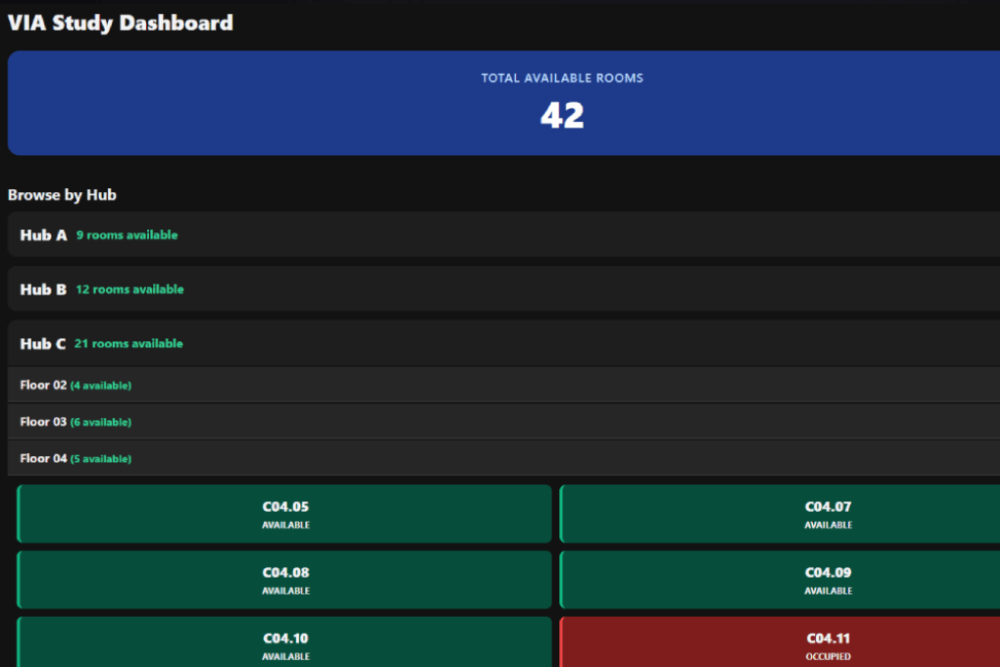
- The Overview Dashboard: A web app (hosted at logaton.diggas.dk) where all students can see the exact number of available rooms live, sorted by building (Hub) and floor.
- Tablet Displays: A dedicated interface for the tablets already installed outside each room (e.g., logaton.diggas.dk/tablet/C04.11).
When a group enters a room, they simply tap the screen, which instantly changes from a clear green "AVAILABLE" to a red "OCCUPIED". This status change is broadcasted immediately to the database, updating the live overview for all other students on campus. No pre-booking, no empty reserved rooms—just raw, real-time data in sync.
Tablet UI


Technical Stack
To ensure the solution was lightning-fast and could scale to both web and mobile, we utilized:
- React Native Expo: To build responsive user interfaces for both the tablets and mobile apps from a single codebase.
- PostgreSQL: As our robust database to handle concurrent status updates across the campus.
- Real-time Synchronization: Ensuring state was broadcasted instantly between the physical rooms and the students' devices.
The Result
At the end of the 24 hours, we successfully pitched our prototype and technical architecture to a panel of industry experts. Our ability to identify a widespread, relatable problem and execute a simple yet highly effective technical solution resulted in a 2nd place finish in the hackathon.