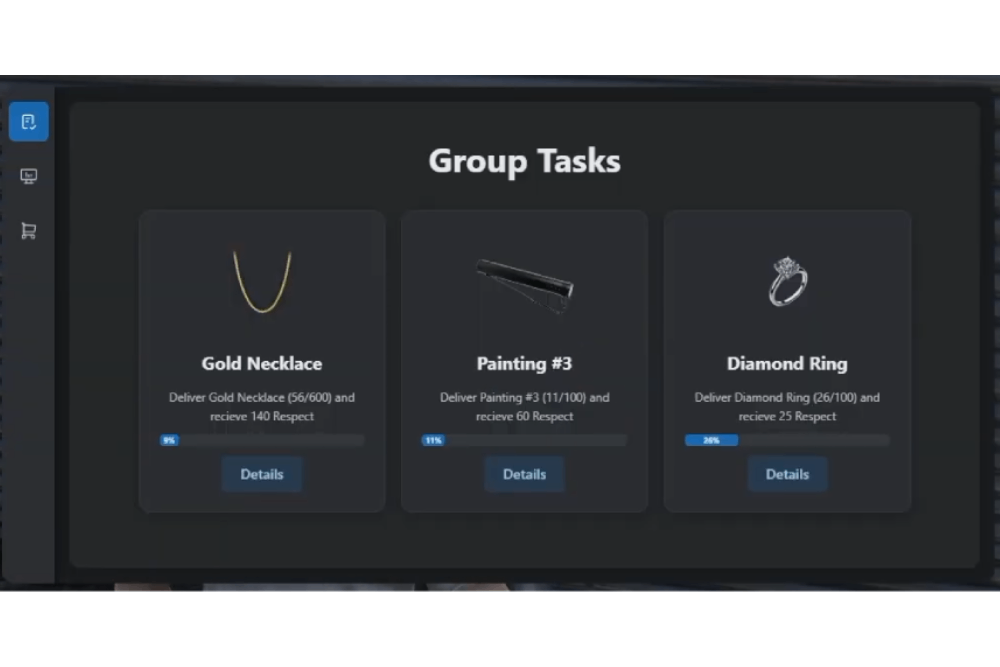
FiveM Development - Group Task System
The Journey
Following the spark ignited by my internship at Systematic, I dove into developing custom resources for the multiplayer modification framework, FiveM. What started as writing simple scripts eventually escalated into engineering full-stack applications with modern web UIs and robust database integrations using MySQL.
One of my most advanced projects during this era was a comprehensive Group Task System.
Real-Time Group Progression
The core concept of this resource was to encourage cooperative gameplay. Players could form groups to complete delivery tasks. By successfully delivering specific items, the group would earn "Respect Points." These points, combined with in-game currency, unlocked the ability to purchase exclusive items.
A major requirement for this system was seamless collaboration. To achieve this, I implemented a broadcast-style pattern: whenever a task's progress updated or respect points were earned, the state was synchronized live across all clients in that specific group. No refreshing needed just instant, real-time feedback.
Tech Stack & Architecture
Building this required a bridge between game engine logic and modern web technologies:
- Backend (Lua): Handled the heavy lifting across both the server-side and client-side game logic.
- Frontend (React): Delivered a sleek, modern, and responsive user interface embedded directly into the game.
- Database (MySQL): Ensured persistent storage for group states, respect points, and economy balances.
- Real-time Synchronization: Utilized server-to-client event broadcasting to keep the React UI instantly updated for all group members simultaneously.
Engineering a Framework Bridge (Adapter Pattern)
Initially, I built the resource strictly for ESX, the most popular FiveM server framework at the time. However, as my development skills matured, I realized the limitations of hardcoding framework dependencies.
To solve this, I engineered a custom bridge utilizing the Adapter Pattern. This abstraction layer translated my resource's core logic so it could communicate seamlessly with any of the popular FiveM frameworks. This modular approach not only made the script highly versatile but was also a fantastic early lesson in writing scalable, decoupled software.